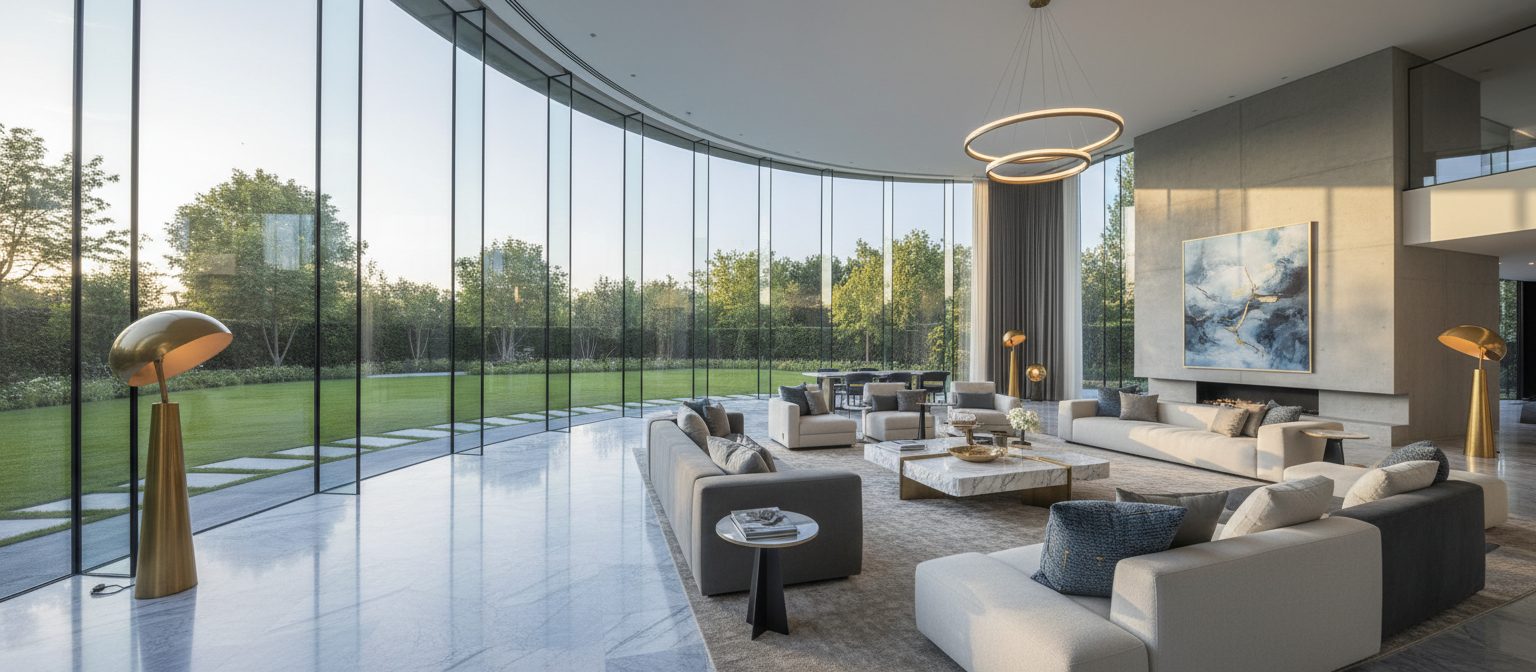
We didn't start as a film company. We started as Architerrax — an architecture and technology consultancy out of Indore — and we got tired of watching beautiful buildings get fitted with switchable glass by vendors who had never once thought about the building.
So we built FrostFlip differently. Every project starts with a site visit by an actual architect, not a salesperson with a sample swatch. We look at your daylighting, your sightlines, your electrical routing, your wall junctions — and we design the film into the space, not onto it. Panel breaks land on mullions, not in the middle of a view. Wiring gets planned before the false ceiling closes, not fished through it afterward. Control zones get mapped to how the room is actually used, not sold as a single blanket switch because that's easier to quote.
That design-first instinct is the whole difference. Anyone with a heat gun and a squeegee can laminate PDLC film onto glass. Getting the detailing, the concealment and the zoning right — so the finished wall reads as intentional architecture rather than a retrofit — takes people who trained on buildings, not on film rolls. It's the difference between a partition that looks like it was always meant to be glass, and one that looks like glass got added afterward.
How we actually work
A FrostFlip project runs in four stages, and none of them are skippable: a free site visit where we measure the actual glass (not the glass on the drawing), a design pass where we plan panel breaks, zoning and wiring routes against your real electrical and ceiling layout, a single site-measured quote with no "starting from" number that mysteriously doubles at the door, and a professional install with our own crew — not a subcontractor we've never met. Pan-India means exactly that: Indore is home base, but the design process and the installation crew travel to Mumbai, Bengaluru, Delhi NCR, Pune and beyond without changing.
The film itself
We source and test premium-grade PDLC film built for Indian conditions — real summers, real humidity, real voltage fluctuation. It switches from frosted to clear in about 0.3 seconds, blocks roughly 99% of incoming UV, draws around 5W per square metre (less than a night lamp), and is rated for 10+ years of daily switching. It fails safe: lose power, and the glass defaults to frosted, so you're never accidentally on display because a breaker tripped. And in frosted mode, it doubles as a genuine rear-projection surface — your boardroom wall becomes a screen without anyone renting a projector stand.
The Numbers
The honest price list
We quote three film grades, priced per square foot of glass, and we'll tell you plainly which one your project actually needs rather than upselling the top tier by default. Installation, controller and remote are priced separately so you can see exactly where your money is going.
Pricing — Per Sq Ft, Installed
Film cost is a premium over ordinary blinds or curtains — but a single film layer replaces blinds, curtains, a projector screen and shatter-resistant safety film all at once. No consumable parts, no recurring dry-cleaning, no motorised tracks to service.
Why architects specify us
We back every quote with the same promise: one site-measured number, no surprises, and a crew that installs it the way we drew it. That accountability only works because the same firm designs the detail and installs the film — there's no vendor to blame when a panel break lands wrong, because we drew the panel break. Film is a commodity available from a dozen importers. Design-first detailing, honest pricing and pan-India accountability are not — and that's why architects keep bringing us their projects that actually matter.